Why Church AV Feels Harder in 2025
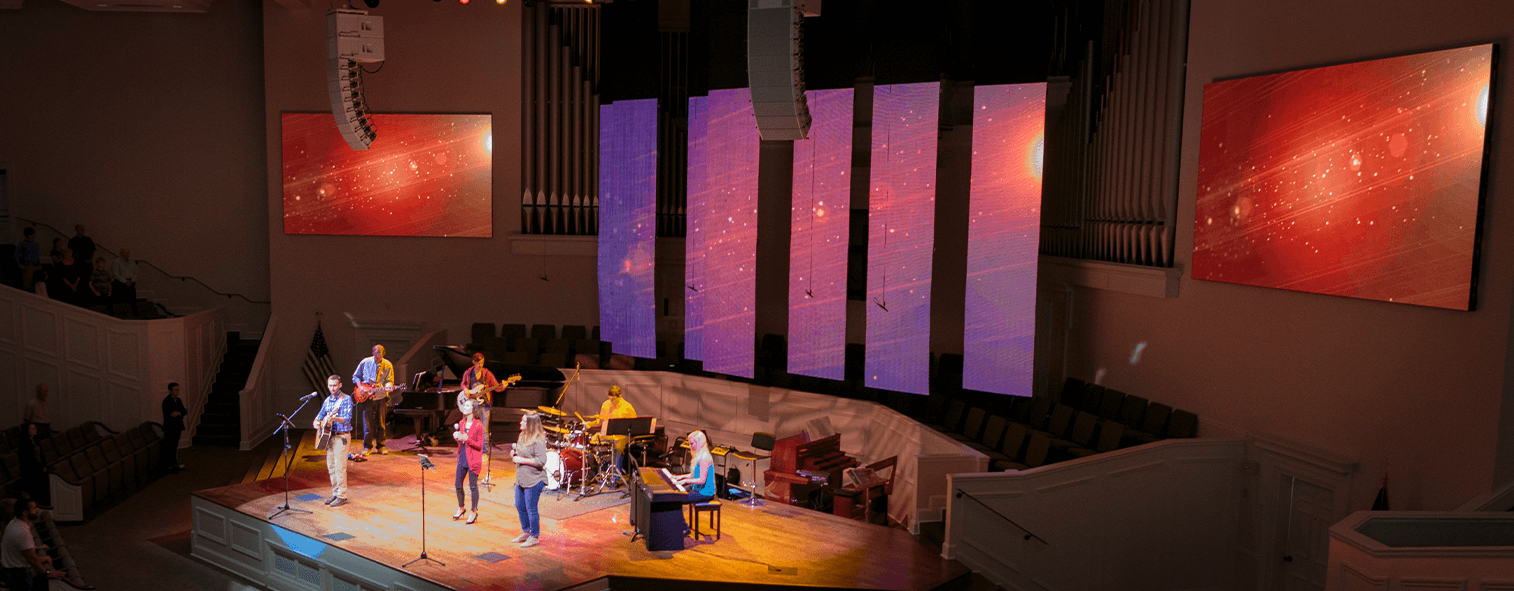
The landscape of church technology has fundamentally changed. What used to be a simple setup—a pulpit mic, a few speakers, and maybe a projector—has evolved into something far more complex. Today’s churches are running what amounts to a live broadcast operation every single Sunday, managing both an in-person sanctuary experience and an online congregation that might number in the hundreds or thousands.
The expectations have risen dramatically. Your online viewers expect crisp audio, professional lighting, and smooth video. Your in-person congregation wants to see lyrics clearly, hear every word, and experience worship without technical distractions. Meanwhile, the team running all this technology is often a rotation of well-meaning volunteers who learned by trial and error.
At S&L Integrated, we’ve walked into hundreds of church tech booths across the country. We’ve seen the same patterns emerge again and again—problems that seem unique to each church but actually follow predictable paths. The good news? Most of these issues have clear solutions. The better news? You don’t have to figure them out through expensive mistakes.
Here are the eleven most common AV challenges we’re helping churches solve in 2025.
1. “I Can’t Hear the Pastor Clearly”
The Complaint
It’s the most common piece of feedback: “I couldn’t understand what Pastor Mike was saying today.” The music overwhelms the message. Sermon audio sounds muddy or muffled. Older members in particular struggle to follow along, and complaints start piling up after service.
What’s Really Happening
Speech intelligibility isn’t about turning up the volume—it’s about clarity. Several factors work against you: your room’s natural acoustics might be reflecting sound in chaotic ways, your speaker system may not provide even coverage across all seating areas, or your mixing approach might be burying vocal frequencies under bass and drums. Many churches are also working with microphones that were adequate ten years ago but don’t meet today’s standards for rejection of ambient noise and clarity of speech.
How an Integrator Solves It
A professional approach starts with understanding your room. We analyze acoustic properties, measure coverage patterns, and identify where sound is being lost or distorted. Then we design speaker systems that deliver consistent clarity to every seat—front row to balcony. We tune your system specifically for speech intelligibility, establish proper gain structure to eliminate noise, and often recommend microphone upgrades that capture the pastor’s voice with remarkable clarity. The goal is simple: every word, understood, everywhere.
2. Feedback, Hotspots, and Dead Zones

The Scenario
In certain sections of your sanctuary, the sound is painfully loud. In others, people strain to hear. During worship, random squeals pierce through the music, forcing your volunteer to frantically pull down faders. Some people complain it’s too quiet; others say it’s uncomfortably loud—and they’re all right.
The Root Cause
These problems stem from physics. Speaker placement determines where sound energy concentrates and where it disappears. When speakers aren’t properly positioned, you create acoustic hotspots (too loud) and dead zones (can’t hear). Feedback happens when microphones pick up sound from speakers, creating a destructive loop. Poor room acoustics amplify these issues—hard surfaces bounce sound unpredictably, creating resonances that your mixing board can’t easily correct.
The Professional Fix
We use acoustic modeling software to predict how sound will behave in your specific space before we hang a single speaker. Strategic placement ensures even coverage. Proper equalization addresses room resonances. Acoustic treatment in key areas controls reflections. The result is a room where the sound level is consistent, feedback is eliminated, and your volunteers can mix with confidence instead of fear.
3. A Livestream That “Works” but Doesn’t Win Guests

The Reality Check
Your church has a livestream. It technically functions. People can watch. But the audio is thin or too quiet, the video occasionally pixelates, and there’s a distracting lag between lips and words. First-time online visitors don’t come back, and you’re not sure why your numbers plateau while other churches grow their digital reach.
What’s Missing
Most churches cobble together their livestream using consumer-grade cameras, free streaming software, and the same audio mix that’s going to the room. The problem is that what sounds balanced in a sanctuary doesn’t translate to earbuds. Consumer cameras struggle in church lighting. Weak encoders can’t handle the upload demands, especially when network traffic spikes. You’re trying to run a broadcast with equipment designed for family video calls.
The Integrator Approach
Professional streaming requires a dedicated signal path. We design systems with broadcast-quality cameras that handle your lighting conditions, encoding hardware that delivers consistent quality, and most critically, a separate audio mix optimized for streaming.
Take First Presbyterian Church in Monroe, Georgia. They were setting up a dated camera on a tripod every single Sunday—someone had to arrive early, get it positioned, run cables, tear it down after service. Their audio picked up more congregational singing than the choir, and the pastor looked distant and disconnected on screen. We installed a PTZ camera specifically for streaming, which not only eliminated the weekly setup hassle but completely resolved their audio balance issues. Now their online viewers get clear, professionally framed video and a properly balanced mix where every element serves the worship experience.
Your online congregation deserves a balanced mix where speech cuts through, music has body but doesn’t overwhelm, and every element is clear. We ensure your network infrastructure can handle the bandwidth, implement monitoring so you know what viewers are experiencing, and integrate everything with your streaming platform seamlessly.
4. Stage Lighting vs. Camera Lighting

The Tension
Your stage looks great in person. The worship lights create atmosphere. The colored LED lighting washes set the mood. But when you review the livestream, your pastor’s face is in shadow, the colors look bizarre on camera, and sunlight streaming through windows keeps throwing everything into chaos.
Understanding the Conflict
Human eyes and camera sensors see differently. What looks “fine” to people in seats can look terrible to a camera. Stage lighting is designed for visual drama and mood, but cameras need specific things: enough light on faces, consistent color temperature, and controlled contrast. Natural light adds another variable—it changes throughout your service, shifting color and intensity in ways that make consistent video nearly impossible.
How We Bridge the Gap
The solution isn’t choosing between in-person and online—it’s designing for both. We create lighting systems with balanced front light that properly illuminates faces for cameras while maintaining the atmosphere your congregation experiences. We use fixtures with controllable color temperature, design scenes that work both in the room and on screen, and develop strategies for managing natural light through blinds, filters, or strategic camera positioning. Your worship experience stays powerful while your video quality becomes professional.
5. Projectors, Screens, and DISPLAYS That Don’t Cut It

The Frustration
People can’t read the lyrics during bright worship songs. Graphics that look crisp on your computer appear washed out and fuzzy on screen. Certain seats have terrible sightlines—people crane their necks or can’t see at all. Your visual communication system, meant to enhance worship, becomes a distraction.
Why It Happens
Many churches bought the biggest projector they could afford years ago, but brightness fades over time and ambient light increases as LED stage lighting becomes more common. Screen size decisions often don’t account for viewing angles from every seat. Aspect ratio mismatches create awkward black bars. Competing light sources wash out the image. What seemed adequate during installation degrades as expectations rise and equipment ages.
The Right-Sized Solution
We start by calculating the actual brightness you need for your space, accounting for ambient light and viewing distances. We help you choose between projection and LED video walls based on your specific situation—budget, ambient light, installation constraints, and longevity needs. We ensure proper sizing so text is readable from the back row, verify sightlines from every seat, and design placement that serves your entire congregation. Whether it’s brighter projectors, larger screens, or a transition to LED video walls, the goal is clarity and readability for everyone.
6. Undertrained Volunteers Carrying Too Much Weight

The Unspoken Burden
Your tech team is mostly volunteers who “learned from the last guy.” They run sound, video, and lights on Sunday mornings, but they’re not confident. They’re afraid to adjust anything unfamiliar. When something goes wrong, panic sets in. Results vary wildly depending on who’s at the board. Burnout is common because the responsibility feels overwhelming without proper training.
The Risk
Inconsistency hurts your ministry. Some Sundays sound great, others are rough. Volunteers quit because they don’t want the stress. Knowledge walks out the door when someone moves away. New volunteers struggle to onboard because there’s no clear system or documentation. Your church’s technical ministry becomes a revolving door of frustrated volunteers.
Building Confidence Through Design
An integrator’s job isn’t just installing equipment—it’s creating systems that volunteers can operate successfully. We design simplified workflows with clearly labeled controls. We build scene presets for different service elements—worship starts, sermon, altar call—so volunteers can push a button instead of adjusting twenty parameters. We create documentation that actually makes sense. Then we provide thorough training, not just on Sunday morning but during the week when people can learn without pressure. We establish ongoing support so when questions arise, answers are available. The goal is volunteers who feel equipped, not overwhelmed.
7. Patchwork Systems Built Over Years

The Reality in Your Tech Booth
Open your equipment rack and you’ll find a history lesson: gear from three different eras, cables that no one’s sure what they do, adapters connecting incompatible formats, and absolutely no documentation. Different brands that don’t quite integrate. Consumer equipment mixed with professional gear. Nothing labeled. When something breaks, troubleshooting becomes archaeological excavation.
Why This Matters
Patchwork systems create hidden problems. Unpredictable behavior happens because equipment wasn’t designed to work together. Troubleshooting takes forever because no one knows the signal path. Scaling is nearly impossible—adding one new feature requires jury-rigging three other components. Training is difficult because every church service depends on institutional knowledge that lives in one person’s head.
The Path to Standardization
We begin with discovery—documenting what you actually have and how it’s connected. Then we develop a standardization plan, identifying what can stay, what needs upgrading, and how to create a cohesive system from the pieces. We replace critical weak links, establish consistent signal flow, and create comprehensive documentation—rack layouts, signal diagrams, and setting sheets that make sense to volunteers. We build a phased roadmap so you can improve over time without a massive upfront investment. The result is a system that’s maintainable, scalable, and understandable.
8. “It Worked Last Week”: Lack of Maintenance
The Sunday Morning Crisis
A wireless microphone dies mid-sentence. The mixing board has noisy faders you have to jiggle just right. Your projector has dimmed so gradually you didn’t notice until someone complains. An HDMI cable works intermittently—sometimes yes, sometimes no, no one knows why. Every week brings a new surprise failure.
The Hidden Cost
Technical equipment needs maintenance, not just emergency repair. Batteries die. Connectors wear out. Firmware updates fix bugs and security issues. Projector lamps dim. Dirt and dust accumulate on critical components. Without regular attention, small issues compound into expensive failures. Emergency replacements always cost more than planned maintenance.
Prevention as Strategy
Professional service agreements transform your approach from reactive to proactive. Regular cleaning keeps equipment healthy. Firmware updates happen on a schedule. Wireless microphone batteries get replaced before they fail. Projector performance gets measured and lamps replaced at optimal intervals. We catch problems during health checks before they become Sunday morning disasters. Annual tune-ups ensure your system sounds as good as the day it was installed. Think of it as budget-friendly insurance—small regular investments prevent large unexpected expenses.
9. A.V. and I.T. on Different Pages
The Conflict
Your AV team needs certain network ports open; IT (information technology department) blocks them for security. The Wi-Fi works fine for office tasks but drops during streaming. Internet bandwidth gets consumed by office traffic right when you go live. When problems occur, AV blames IT and IT blames AV. Nothing gets resolved because neither side understands the other’s requirements.
Why This Happens
Modern church technology sits at the intersection of traditional AV and IT infrastructure. Streaming requires network bandwidth. Control systems use IP addresses. Wireless microphones compete with Wi-Fi frequencies. But AV vendors and IT departments often speak different languages, have different priorities, and don’t coordinate during planning. The result is systems that technically work but conflict in practice.
The Bridge
A modern integrator understands both worlds. We design network infrastructure specifically for AV requirements—proper VLANs to separate streaming traffic from office data, Quality of Service settings that prioritize critical signals, and documented network configurations that IT departments understand. We coordinate with your IT team during planning, create clear documentation that bridges technical languages, and establish protocols for troubleshooting. When AV and IT work together from the beginning, conflicts disappear and systems perform reliably.
10. Ignoring Accessibility and Inclusivity
The Quiet Problem
Certain members of your congregation struggle to follow services. Older members with hearing loss strain to understand but don’t complain—they just stop coming. People using assistive devices get mixed results. Your online stream might sound fine to young people with good hearing but excludes others. You’re unintentionally creating barriers to worship.
Why It Matters
Accessibility isn’t optional—it’s pastoral care through technology. Poor audio mixing, lack of assistive listening systems, and inattention to how different people experience sound can quietly exclude significant portions of your congregation. Every Sunday, you might be losing people who want to engage but can’t overcome technical barriers.
Inclusive Design
We help churches implement assistive listening systems that let hearing aid users connect directly to your sound system. We train mixing approaches that maintain speech clarity—critical for older ears and online listeners. We design systems that serve the full range of your congregation’s needs, from teenagers with perfect hearing to elderly members who struggle with certain frequencies. Accessibility becomes a technical priority because it’s a ministry priority.
11. Budgeting for Gear, Not for Strategy
The Typical Approach
Something breaks, so you buy the least expensive replacement. Someone suggests an upgrade, so you research the cheapest option. Your AV budget consists of reactive purchases—fixing what fails, adding what seems immediately necessary. There’s no long-term plan, no coordination with building projects, no alignment with ministry vision. You’re spending money but not building value.
The Hidden Costs
Reactive spending costs more over time. Cheap equipment fails sooner, requiring replacement. Disconnected purchases create integration problems. You miss opportunities to coordinate AV upgrades with building renovations, resulting in double expenses. Training and support get ignored, so expensive equipment sits underutilized. The total cost of ownership—including maintenance, training, and eventual replacement—never gets considered.
Strategic Planning
Professional integrators build phased plans aligned with your church’s vision. We consider a three to seven year horizon, coordinating technology upgrades with building projects and ministry goals. We discuss total cost of ownership, including training and support, not just equipment price tags. We create roadmaps that let you improve over time without emergency spending. We help you understand when to invest in quality that lasts versus when adequate is acceptable. The result is better stewardship—your AV budget becomes an investment in ministry effectiveness, not just a series of expenses.
Next Steps for Your Church
If you’ve recognized your church in any of these scenarios, you’re not alone. These are the patterns we see across hundreds of churches—and the good news is that solutions exist.
At S&L Integrated, we believe the first step shouldn’t be overwhelming or expensive. We offer low-pressure AV assessments and discovery calls where we simply listen to your challenges and help you understand your options.
Start here:
- Sunday Health Check Visit: We attend a service, experience what your congregation experiences, and provide honest feedback about what’s working and what isn’t.
- Remote Consultation: Send us photos of your tech booth, floor plans, and your current equipment list. We’ll review everything and identify your biggest opportunities for improvement.
- Discovery Call: No sales pressure, just conversation. Tell us what you’re trying to accomplish, and we’ll share whether we can help and what the path forward might look like.
Your church’s technical ministry doesn’t have to feel overwhelming. With the right partner, these common problems become solved challenges, freeing your team to focus on what matters most—helping people encounter God.
Ready to talk? Contact S&L Integrated today and let’s start the conversation about your church’s AV future.