In modern heavy manufacturing, the gap between what workers need to know and what they actually know at any given moment is costing the industry a staggering amount. According to the Siemens True Cost of Downtime 2024 report, unscheduled downtime now saps 11 percent of annual revenues from the world’s 500 biggest companies — a total of $1.4 trillion, up from $864 billion just five years ago. In the automotive sector alone, the per-hour cost of downtime reaches $2.3 million, or $600 every second.
The industrial LED video wall is increasingly the answer to that communication gap. These are not décor decisions. They are operational infrastructure — and the data supporting their deployment is substantial. This article outlines six core reasons why leading manufacturing operations are making the investment.
1. Real-Time Visibility Directly Attacks the Cost of Downtime
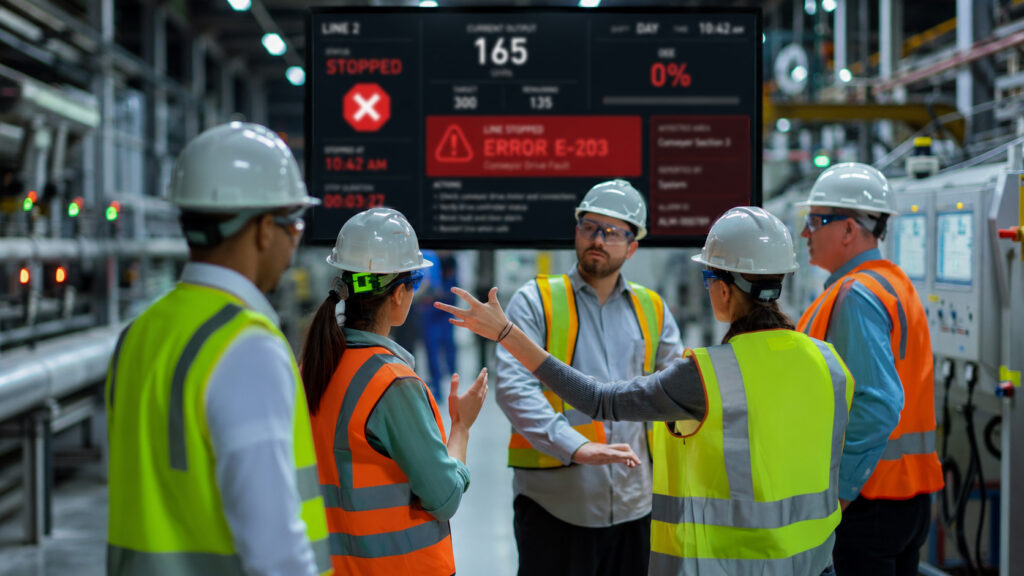
When a line stoppage or supply bottleneck occurs, time-to-response is everything. Traditional Andon boards, fragmented monitors, and PA systems create communication lag — the wrong people learn too late, through too many layers.
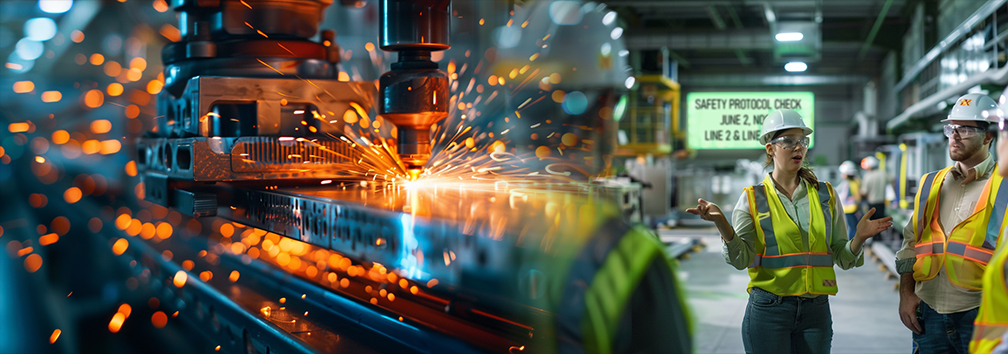
A large-format LED wall integrated directly with a Manufacturing Execution System (MES) collapses that lag. Because these high-brightness displays are legible from hundreds of feet away with no bezels or screen breaks, floor managers and line operators receive the same accurate information simultaneously. Replacing bulletin boards, PA systems, and word-of-mouth with digital displays reduces transcription errors and accelerates decision-making the moment production problems arise.
Approximately 90% of manufacturing businesses now rely on digital signage to reinforce training and improve output.
As facilities move toward Industry 4.0 operations, the LED video wall becomes the visible layer of an otherwise invisible data infrastructure — converting live MES, ERP, and IIoT feeds into a single, plant-wide source of truth.
2. Safety Performance: The Numbers Are Measurable
Safety failures carry costs across every line of the P&L: injury claims, regulatory exposure, workers’ compensation, and lost production. The scale is significant — Liberty Mutual’s 2025 Workplace Safety Index, cited by OSHA, estimates U.S. employers pay more than $1 billion per week in direct workers’ comp costs for non-fatal injuries alone. The National Safety Council puts the total national burden at nearly $1.2 trillion in 2022.
The return on prevention is equally clear. A peer-reviewed study cited directly by OSHA found workplaces that underwent Cal/OSHA inspections saw a 9.4% drop in injury claims and 26% average savings on workers’ compensation — roughly $355,000 per firm over four years. More than 60% of CFOs surveyed by Liberty Mutual confirmed that every $1 invested in injury prevention returns $2 or more. (Source: osha.gov/businesscase)
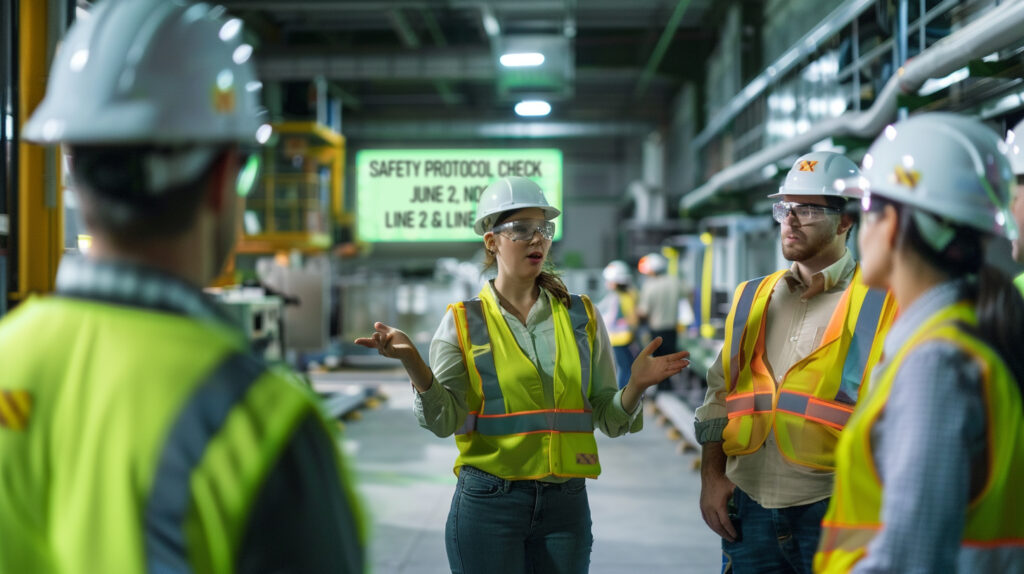
The problem in heavy manufacturing is delivery. Email doesn’t reach the floor. Bulletin boards go unread. Verbal briefings cover one shift, not three. A plant-wide LED wall solves that gap: pushing live safety alerts, compliance reminders, and hazard warnings to every zone simultaneously, with no relay chain and no information lost between crews.
3. Workforce Productivity Has a Proven Link to Visibility
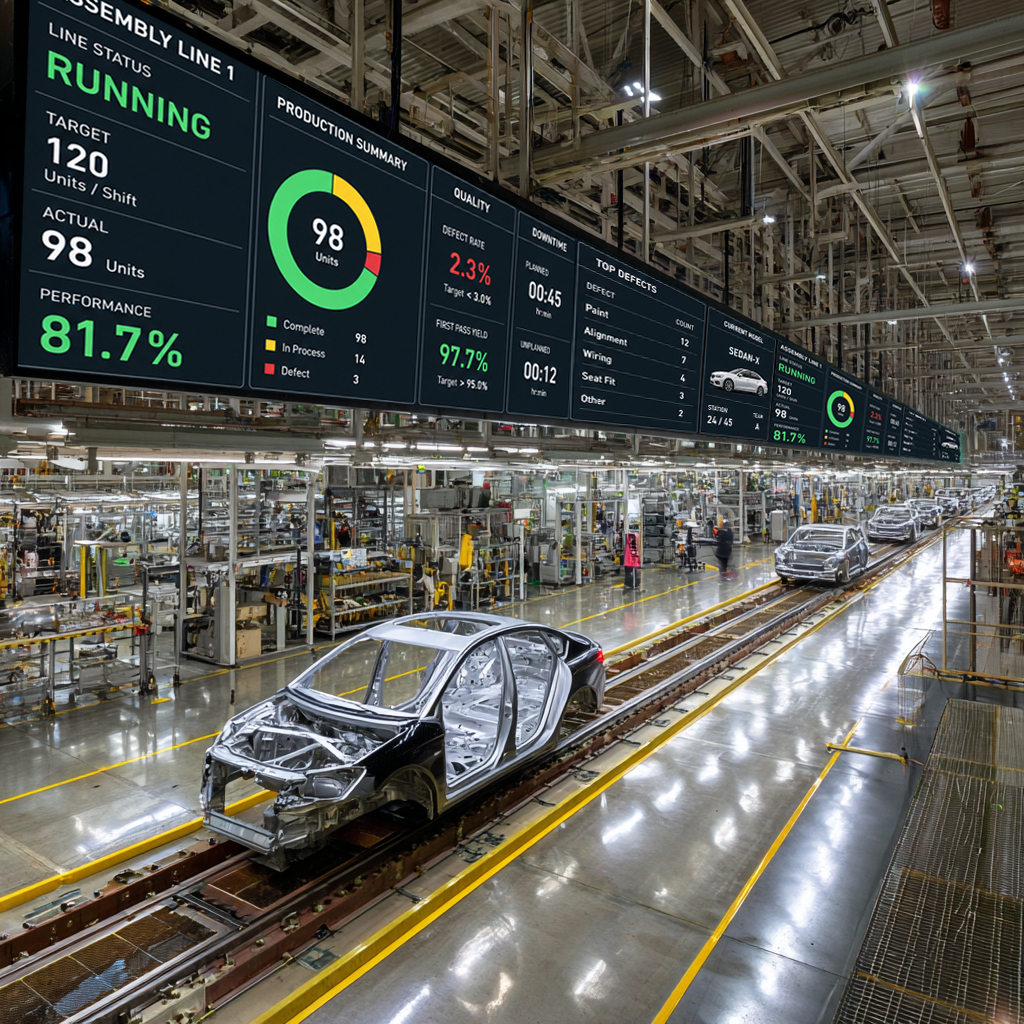
Over 83% of employees report being more satisfied at work when they know what’s happening around them. On the factory floor, that figure has direct operational consequences. When line workers can see real-time production targets versus actuals above their station, they self-correct faster, take ownership of output, and require fewer supervisory interventions.
Displaying live KPIs on the floor transforms abstract company goals into a scoreboard workers can see and act on. It creates personal accountability without additional management overhead — teams that know the score in real time perform measurably differently from those operating in an information vacuum.
Good internal communication drives up to 25% higher employee productivity — not through motivation campaigns, but simply by keeping people informed.
4. Company-Wide Communications: Replacing the Bulletin Board for Good
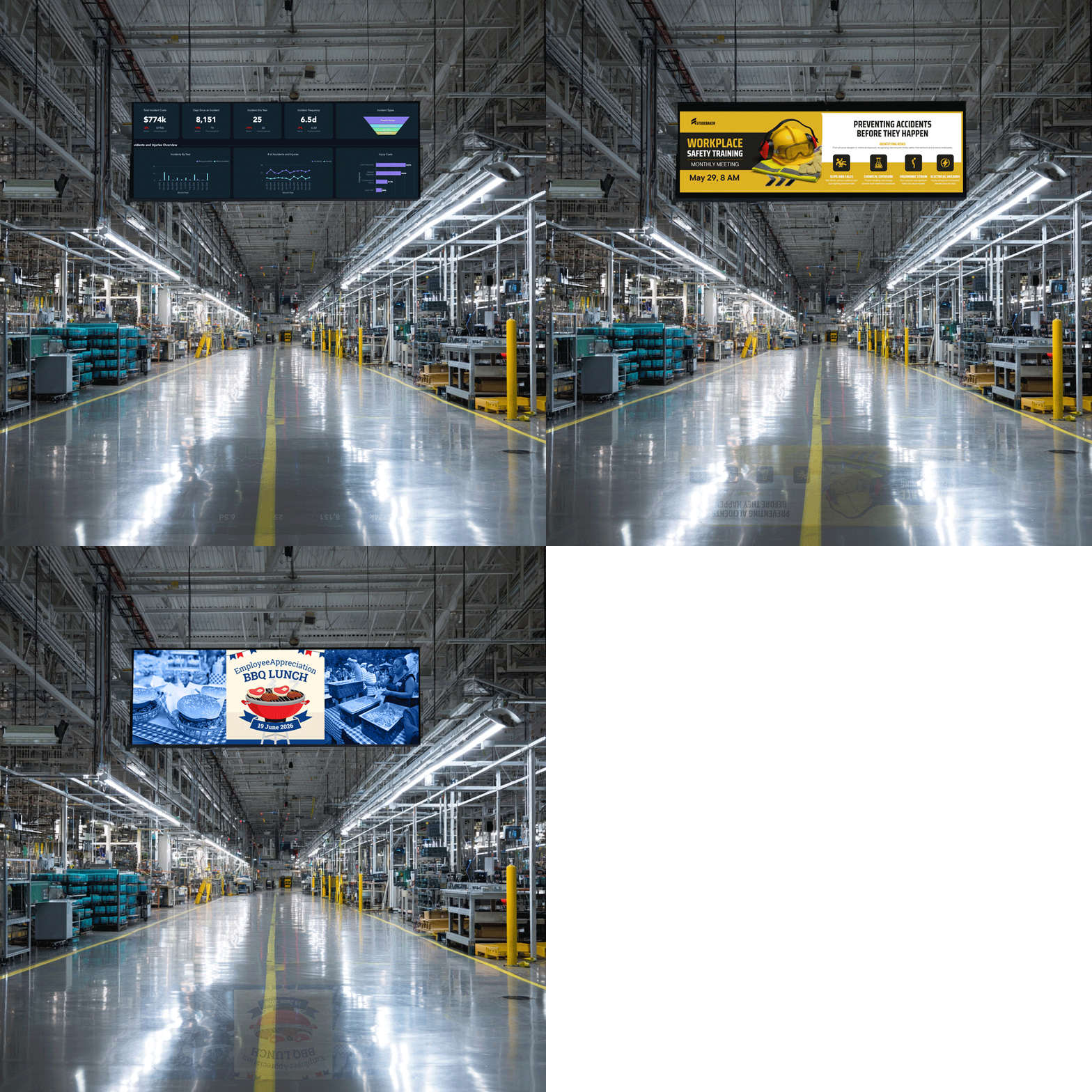
Picture the typical communications infrastructure of a heavy manufacturing plant: paper notices taped to break room walls, email blasts that never reach floor workers who don’t sit at desks, PA announcements lost in ambient noise, and printed shift memos that are outdated before the next crew reads them. It is fragmented, unreliable, and invisible to large portions of the workforce.
The LED video wall, managed through a centralized content system, eliminates every one of those channels and replaces them with a single controlled, plant-wide communication infrastructure. HR announcements, policy updates, benefits enrollment reminders, holiday schedules, shift changes, and leadership messages all go to one place — appearing instantly across every screen in the facility, from the main floor to breakrooms to entry points where every worker passes at the start and end of each shift.
The engagement difference is not marginal. Employees are 400% more likely to engage with visual information than plain text. Organizations deploying screens for internal communication see up to 350% higher message engagement compared to email alone, alongside a significant reduction in printing and distribution costs across departments.
350% higher message engagement vs. email. For a workforce that never sits at a desk, the screen on the wall is the only reliable communications channel.
For multi-shift operations, this is especially valuable. New hires onboard faster, shift handovers become seamless, and training retention improves because the information is visual and present exactly where workers need it. The same display showing line output targets at 6 a.m. can carry a policy update at shift break, recognize a team milestone at midday, and brief the incoming crew on operational changes before they reach their stations.
The bulletin board didn’t just fail because it looked outdated. It failed because it was passive, static, and required workers to seek it out. A plant-wide LED system is none of those things.
5. Scalability and the Path to Smart Manufacturing
A single LED video wall is not a standalone display — it is an integration node. Modern installations connect directly to IIoT platforms, ERP systems, MES dashboards, and safety management software, pulling live data into a unified visual output. As facilities expand or upgrade their underlying systems, the display infrastructure scales with them: content sources, screen configurations, and data feeds can all be reconfigured without replacing hardware.
This positions the LED video wall as a long-term platform rather than a point solution. As manufacturing operations grow more data-intensive — incorporating predictive maintenance systems, AI-driven quality monitoring, and global supply chain tracking — the need for a centralized, high-visibility output layer only increases. The physical infrastructure put in place today supports the data workflows of the next decade.
The Bottom Line
A heavy-manufacturing facility making this investment deserves a clear-eyed return case. The evidence points to five compounding financial drivers: reduced downtime response costs, measurable safety incident reduction, improved workforce output and retention, plant-wide communications that actually reach every worker, and a scalable platform that grows with the facility’s digital infrastructure.
The upfront number is real. So is the cost of not having it, measured every second a line sits idle, every safety incident that could have been prevented, every shift that begins without a team knowing whether it’s on target, and every company announcement that gets taped to a wall and ignored.
Sources: Siemens True Cost of Downtime 2024 | OSHA Digital Safety Signage Research | SNS Insider LED Video Wall Market Report 2026 | CrownTV Digital Signage ROI Analysis | Dynamo LED Displays TCO Analysis | DoitVision TCO Comparison Study