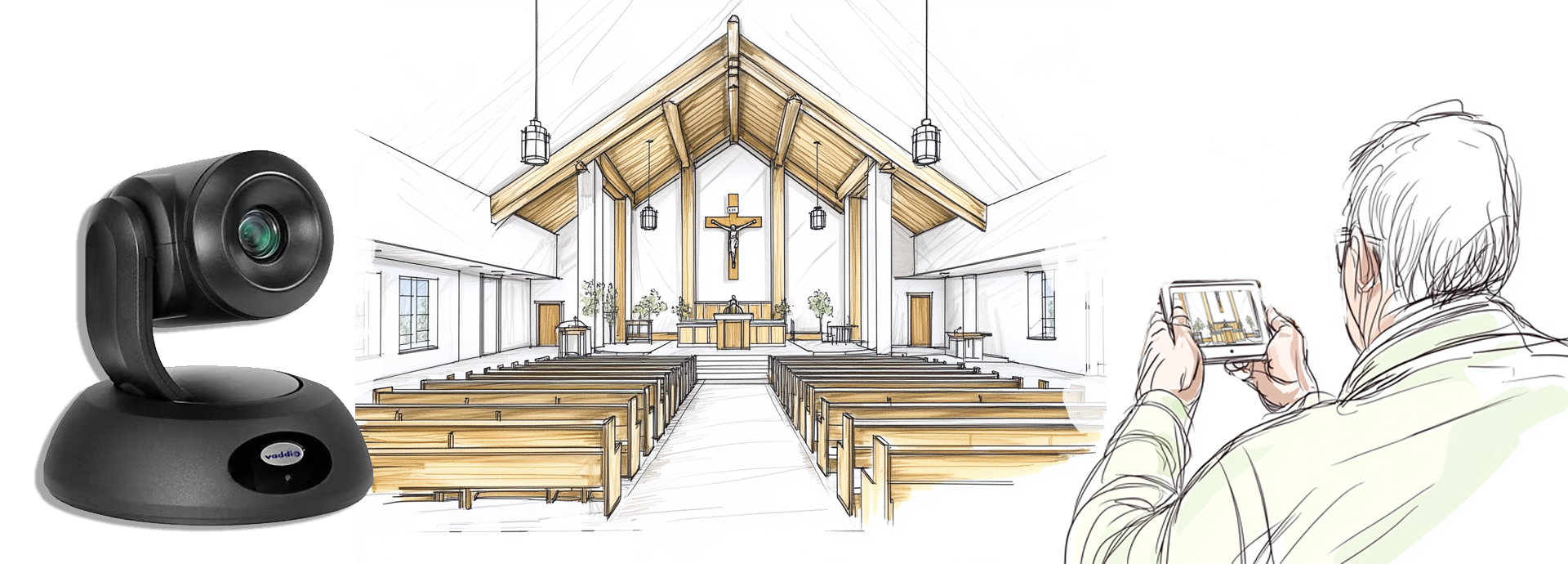
In today’s digital age, churches are increasingly turning to live streaming to reach congregants beyond the sanctuary walls. Whether it’s for members who are homebound, traveling, or part of a growing online community, streaming services have become a vital part of modern ministry.
One of the most effective tools for this purpose is the PTZ (Pan-Tilt-Zoom) camera.
PTZ cameras offer flexibility, professional-quality video, and remote control capabilities, making them ideal for houses of worship. In this guide, we’ll explore how PTZ cameras can elevate your church’s streaming experience, whether you’re working with a single camera or a multi-camera setup.
What is a PTZ Camera?
A PTZ camera is a video camera that can be remotely controlled to pan left and right, tilt up and down, and zoom in or out. These cameras are often mounted on walls, ceilings, or tripods. Best of all, they can be operated via joystick controllers, software, or even mobile apps.
The key benefits of PTZ cameras include:
- Remote operation: No need for a camera operator in the sanctuary
- Discreet design: Blends into the environment without distracting the congregation
- High-quality video: Many models offer HD or 4K resolution
- Preset positions: Quickly switch between different angles with a single click
Single-Camera Setup: Simple and Effective
For smaller churches or those just beginning their streaming journey, a single PTZ camera can be a powerful solution.
With strategic placement—typically at the back of the sanctuary or mounted high on a wall—you can capture a wide view of the pulpit, altar, and congregation.
Ideal Uses:
- Live streaming sermons to Facebook, YouTube, or your church’s website
- Recording services for later viewing or archival purposes
- Zoom integration for virtual Bible studies or prayer meetings


Advantages:
- Cost-effective: Lower investment in equipment and installation
- Ease of use: Fewer technical requirements and simpler operation
- Minimal disruption: Less visible equipment in the worship space
Real-World Success Story
William Collins, a retired minister and account executive for S&L Integrated, shares a recent success story: “We recently installed a single PTZ camera for a small church. They wanted an option to stream their service to Facebook without having to haul in a tripod and camera to sit in the middle of the aisle every Sunday. We mounted a PTZ camera about 12 feet high at the back of the sanctuary. It is unobtrusive, has a better video angle and quality than the previous solution, and it doesn’t require anyone to set it up each Sunday or leave wires in the way that can be tripped over. The audio doesn’t allow members singing voices to overshadow the entire audio, and the overall audio quality has been improved tenfold. The single camera solution wasn’t very expensive and it has been well received by the church.”
This example perfectly illustrates how a single PTZ camera can solve common streaming challenges while enhancing the worship experience for both in-person and online congregants.
Multi-Camera Setup: Dynamic and Professional
Ready to take your streaming to the next level? Larger churches or those looking to create a more engaging online experience often find that a multi-camera setup transforms their digital ministry.
This typically involves two to four PTZ cameras positioned at different angles. Think wide shots of the sanctuary, close-ups of the pulpit, side views of the choir, and crowd reaction shots.
Ideal Uses:
- Multi-angle live streaming for a more immersive viewer experience
- Event coverage such as weddings, baptisms, and concerts
- Hybrid services combining in-person and online worship
Advantages:
- Auto-Tracking: Most PTZ cameras feature automatic motion tracking that smoothly follows speakers with fluid camera movements.
- Professional production value: Smooth transitions between camera angles
- Greater storytelling: Highlight different parts of the service or focus on speakers and musicians
- Scalability: Easily expand your setup as your needs grow
Choosing the Right PTZ Camera
With so many options available, selecting the perfect PTZ camera for your church might seem overwhelming. Here are the key features to prioritize:
Resolution: Look for at least 1080p HD; 4K is ideal for future-proofing.
Zoom range: Optical zoom (e.g., 20x or 30x) is crucial for capturing distant subjects clearly.
Low-light performance: Important for dimly lit sanctuaries.
Connectivity: Ensure compatibility with your streaming platform. Look for HDMI (standard video output), SDI (professional broadcast standard), NDI (network video transmission), or USB connections.
Control options: Choose between hardware controllers, software, or app-based control.
Integration and Workflow
A successful streaming setup involves more than just cameras. You’ll also need several key components working together seamlessly.
Video switchers help you toggle between camera feeds during live broadcasts.
Audio integration connects with your church’s existing sound system to ensure clear, professional audio quality.
Streaming software like OBS (free open-source option), vMix (professional live production), or Wirecast (user-friendly broadcasting) manages your live stream output.
Reliable internet ensures smooth, uninterrupted broadcasts that keep your online congregation engaged.
Don’t forget the behind-the-scenes essentials: proper cable management, adequate power supply, and solid network configuration are all critical for a seamless experience.
Ready to Transform Your Church’s Streaming Experience?
Designing and implementing a PTZ camera system can feel overwhelming—but you don’t have to do it alone.
At S&L Integrated, we specialize in helping churches of all sizes bring their vision to life. From assessing your unique space and recommending the right equipment to installing everything and training your team, we guide you through every step of the design and build process.
Whether you’re starting with a single camera or planning a full-scale production setup, our team is here to ensure your church’s message reaches every heart—near and far.
Ready to get started? Let’s discuss how we can help your church connect with more people through the power of professional streaming technology.